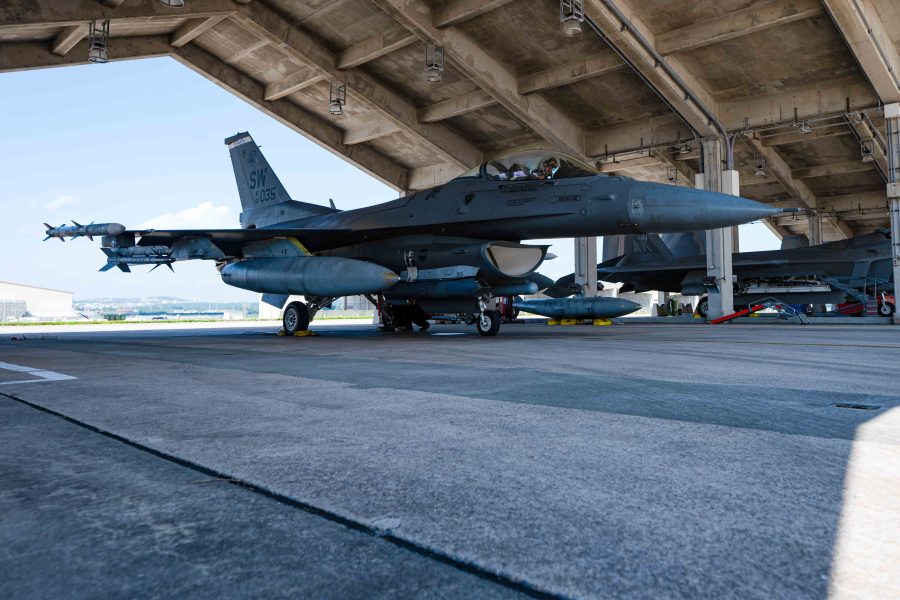
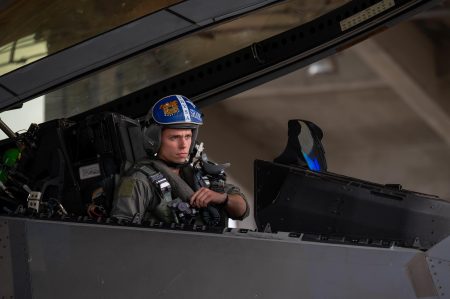
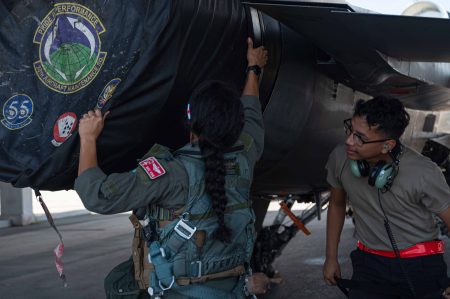
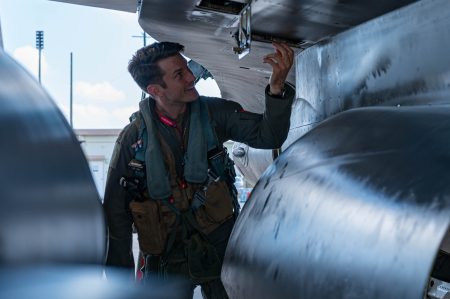
A U.S. Air Force F-16C Fighting Falcon, assigned to the 77th Expeditionary Fighter Squadron, Shaw Air Force Base, S.C., prepares to taxi before its first flight during a temporary deployment at Kadena Air Base, Japan, Oct. 9, 2024. The transition to more modern aircraft at Kadena exemplifies the U.S. Air Force’s continued commitment to enhancing posture and building on the strong foundation of the U.S.-Japan alliance. (U.S. Air Force photo by Airman 1st Class Catherine Daniel)
Audio of this article is brought to you by the Air & Space Forces Association, honoring and supporting our Airmen, Guardians, and their families. Find out more at afa.org
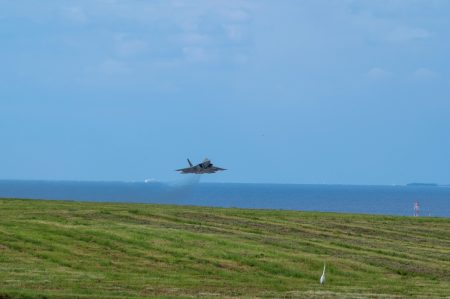
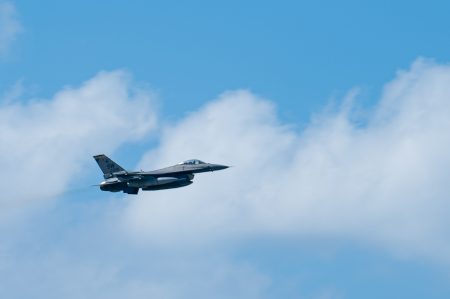
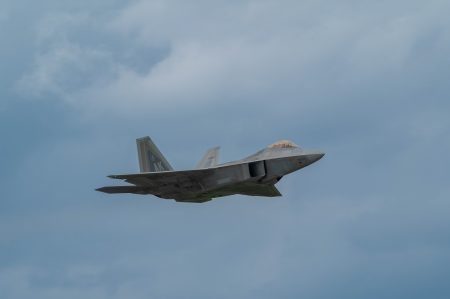
Fresh F-22 and F-16 fighter jets arrived at Kadena Air Base, Japan, this past weekend as the key Pacific base phases out its few remaining F-15C Eagles.
The F-16s are from the 77th Expeditionary Fighter Squadron out of Shaw Air Force Base, S.C. The F-22s are from the 525th Expeditionary Fighter Squadron out of Joint Base Elmendorf-Richardson, Alaska.
In addition to the incoming fighters, F-22s from the 27th Expeditionary Fighter Squadron out of Joint Base Langly-Eustis, Va., remain at the base.
Kadena continues to hold onto some F-15Cs—a staple of the installation since the late 1970s—which are nearing the end of their lifespan.
Stars and Stripes first reported the new fighters’ arrival. A spokeswoman for Kadena’s 18th Wing confirmed their presence to Air & Space Forces Magazine and also confirmed that “there are F-15C Eagles remaining at Kadena as they wait to be phased out.”
Kadena’s aging F-15Cs have been slowly leaving the base for months following the Air Force’s decision in October 2022 to phase the fleet out and temporarily replace it with a rotation of fourth- and fifth-generation fighters.
The 18th Wing has consistently refused to disclose how many F-15Cs remain at Kadena, citing operational security concerns. In August, however, it did note the departure of a four-ship of Eagles as a “milestone” in the drawdown.
Service officials have declined to say when the last F-15C will leave.
Kadena is expected to eventually welcome 36 F-15EX fighters as the permanent replacement for the F-15Cs, part of a larger force restructuring on Japan that will see F-35s go to Misawa Air Base. The new F-15EXs will boast additional weapon stations, new electronic warfare suites, fly-by-wire flight controls, a far more powerful set of processors, and new cockpit displays. The notional date for fully equipping Kadena with the F-15EX is 2026.
“There will be some learning as it comes to putting a new platform into these environments and we’ll probably learn a few lessons about the capabilities of the F-15EX,” Pacific Air Forces commander Gen. Kevin B. Schnider told Air & Space Forces Magazine last month. “I don’t think it’s going to be a significant transition at all to bring a new platform into Kadena just because the people that are operating that platform already know the business.”
The Air Force’s closest base to the island of Taiwan, Kadena is considered a key strategic location for the U.S. in its competition with China and has hosted a continuous cycle of fighters in the past two years. Most recently, F-22s from Joint Base Pearl Harbor-Hickam, Hawaii, departed after a six-month rotation at the base.
The Air Force’s fighter fleet as a whole faces heavy demand as of late. Additional F-15s, F-16s, and A-10s are deploying to the Middle East amid rising tension between Israel and Iran, while squadrons of jets are extending their deployments to bolster U.S. airpower in the region.
Audio of this article is brought to you by the Air & Space Forces Association, honoring and supporting our Airmen, Guardians, and their families. Find out more at afa.org
The Air Force announced Aug. 13 it recently tested prototypes for a portable ground station for commanding and controlling semi-autonomous Collaborative Combat Aircraft, and a spokesperson now says the plan is to award a contract for the effort next summer.
One year into a new campaign to boost readiness rates for the B-1B Lancer and B-52H Stratofortress bombers, Air Force Global Strike Command is claiming some early wins and planning to forge ahead with more improvements.
Over the past few months and peaking in August, crews with the 910th Airlift Wing out of Youngstown Air Reserve Station, Ohio, have been running nighttime, low-flying missions to kill a ubiquitous and deadly adversary that’s plagued Americans for centuries—mosquitoes.
An Iranian ballistic missile attack on a key U.S. air base in Jordan damaged multiple U.S. warplanes, people familiar with the matter confirmed to Air & Space Forces Magazine.
General Atomics has unveiled the first renderings of its Wildfire drone, which it plans to pitch for the Air Force’s hunt for a new, low-cost Massed Modular Aircraft.
In the small world of Air Force weather specialists, combat weather specialists are a niche unto themselves, deploying with Army ground units to provide forecasts and, if need be, fight alongside those Soldiers. For Staff Sgt. Francisco Estrada, the hardest part of the job isn’t the possibility of ground combat,…
Startups Anduril Industries and Heremus have agreed to integrate Anduril’s autonomy software onto Hermeus’ hypersonic demonstrator aircraft “Quarterhorse”—uniting two technologies that have drawn keen interest and investment from the Air Force.
In a dramatic flare-up in the hostilities between the U.S. and Iran, American forces struck and destroyed five Iranian oil tankers Sept. 8, U.S. Central Command said. Iran retaliated by lobbing ballistic missiles toward a major U.S. base in Jordan.
✓
Thank You!
Check your inbox to verify your email address and finish setting up your AFA account.
★
Welcome Back!
An account with this email already exists. Please log in to continue.
Subscribe to the Air & Space Forces Daily Report
The latest news from Air & Space Forces Magazine, as well as news from other leading publications, delivered right to your inbox every morning!
We’re sorry, there has been an error. Please review your input or try again later.