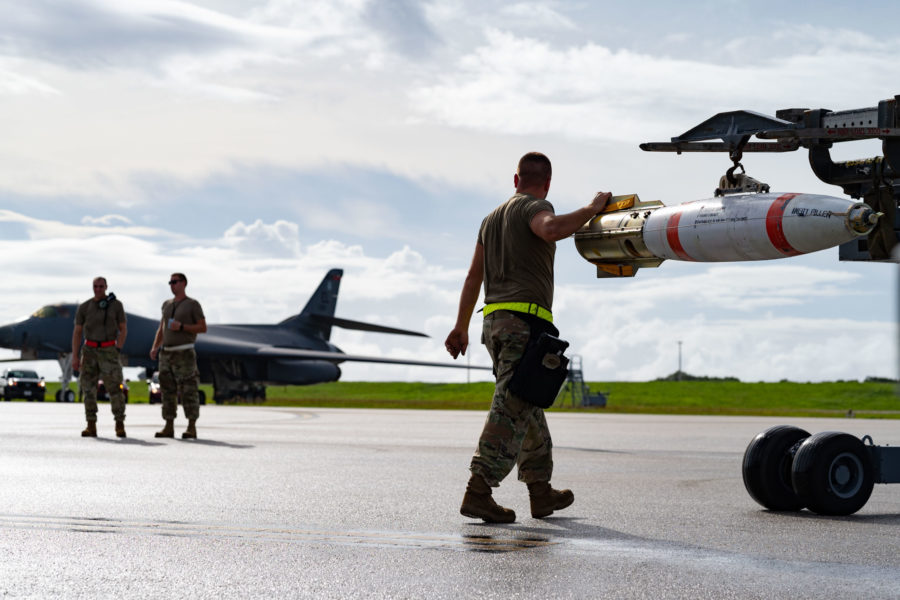
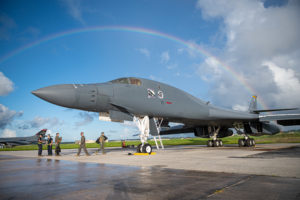
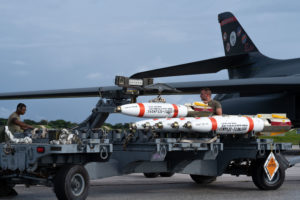
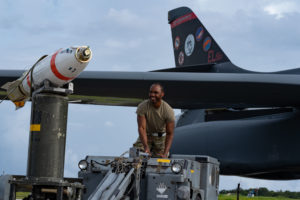
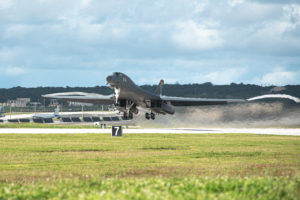
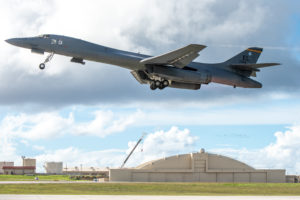
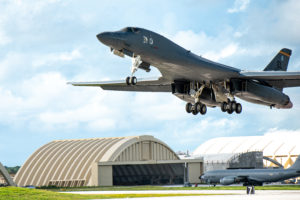
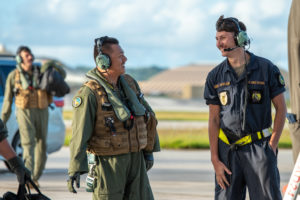
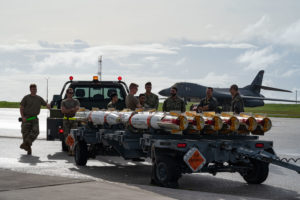
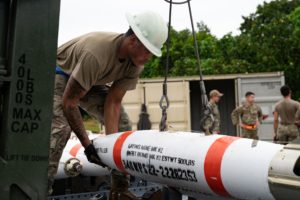
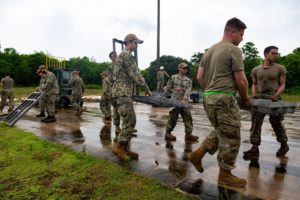
An Airman assigned to the 28th Munitions Squadron, Ellsworth Air Force Base, S.D., prepares to load an MK-62 Quickstrike Naval mine onto a B-1B Lancer in support of a bomber task force mission at Andersen Air Force Base, Guam, Oct. 21, 2022. Air Force photo by Staff Sgt. Hannah Malone.
Audio of this article is brought to you by the Air & Space Forces Association, honoring and supporting our Airmen, Guardians, and their families. Find out more at afa.org
B-1B Lancers deployed to Guam for a bomber task force joint training mission with the Navy, with Airmen and Sailors practicing loading and releasing naval mines from the B-1s.
The naval mine exercise, or MineX, took place Oct. 24, staged out of Andersen Air Force Base, according to a release from Pacific Air Forces.
As part of the exercise, Sailors from Navy Munitions Command’s Pacific Unit built and delivered the Mark-62 Quickstrike mines, then worked with Airmen from the 28th Munitions Squadron to load them onto the B-1s.
All told, an undisclosed number of B-1s were loaded with 21 mines total, each mine weighing about 500 pounds. A B-1 can carry up to 84 of the mines.
“MineX missions require close coordination and integration between the Navy and the Air Force,” Col. Chris McConnell, 37th Bomb Squadron commander, said in a statement. “As one of the aircraft capable of releasing mines, we have to work with our Navy partners to understand where those munitions need to be placed to meet the desired objectives.”
McConnell also stated that as part of the mission, the B-1s flew alongside “Navy partners and allies,” though PACAF did not specify what other aircraft or partner nations were included in the mission.
The exercise marks a quick start for the B-1s’ bomber task force deployment on Guam. An undisclosed number of the bombers from Ellsworth Air Force Base, N.D., arrived there Oct. 18. It marks the second time this year that B-1s have been deployed to Guam and the first BTF mission in the Indo-Pacific this fall.
The Ellsworth B-1s are no strangers to naval mine exercises, though. Just this past August, a B-1 from the 28th Bomb Wing was loaded with a Mark-65 Quickstrike mine and flew from Ellsworth to off the coast of California, where it dropped the munition. A similar exercise took place in 2014.
B-1s from Dyess Air Force Base, Texas, also dropped Mark-62 Quickstrike mines as part of Exercise Baltic Operations in 2018.
None of those B-1 exercises, however, took place in the Indo-Pacific, where the Pentagon has placed an increased emphasis as of late as part of its strategic competition with China—the Air Force and Navy did work together during Exercise Valiant Shield in 2018 and in 2019 to load and drop naval mines.
The B-1B is capable of carrying up to eight Mark-65 Quickstrike mines, which weigh 2,000 pounds each.
Audio of this article is brought to you by the Air & Space Forces Association, honoring and supporting our Airmen, Guardians, and their families. Find out more at afa.org
The Air Force is accelerating its plans to field an MQ-9A replacement in the wake of heavy Reaper losses in operations against Iran, top officials said Sept. 3, and they’re targeting a price point of just $10 million per aircraft.
The U.S. is rotating fresh fighter squadrons to the Middle East to support the Trump administration’s open-ended campaign of economic and military pressure against Iran.
An F-16 Air National Guard unit’s six-month deployment to Kadena Air Base, Japan, this year illustrated the capabilities the Guard’s oldest fighter units can still offer—but also the challenges they face, officials told reporters this week.
The last EC-130H Compass Call in the Air Force’s active inventory made its final flight Sept. 2, as the service prepares to retire the venerable electronic warfare aircraft and pivot to the new EA-37B.
Air Force B-52 Stratofortress bombers landed at a northern Australian air base this week, a major display of the U.S. military’s ability to project force in the Pacific.
The base cost of an F-35A, the Air Force variant of the Joint Strike Fighter, is going up 11.5 percent from $82.5 million to $92 million for the latest lots of the fifth-generation aircraft, Air & Space Forces Magazine has confirmed.
The Air Force Research Laboratory has signaled to industry it wants to develop a low-cost hypersonic cruise missile to deliver a wide range of payloads at a range up to 500 nautical miles.
The Air Force’s decision to more than double its purchase of F-15EX Eagle II jets may bolster the service’s fighter fleet, but it also comes with risks and questions officials will have to manage in the years ahead, a new Pentagon report warns.
✓
Thank You!
Check your inbox to verify your email address and finish setting up your AFA account.
★
Welcome Back!
An account with this email already exists. Please log in to continue.
Subscribe to the Air & Space Forces Daily Report
The latest news from Air & Space Forces Magazine, as well as news from other leading publications, delivered right to your inbox every morning!
We’re sorry, there has been an error. Please review your input or try again later.