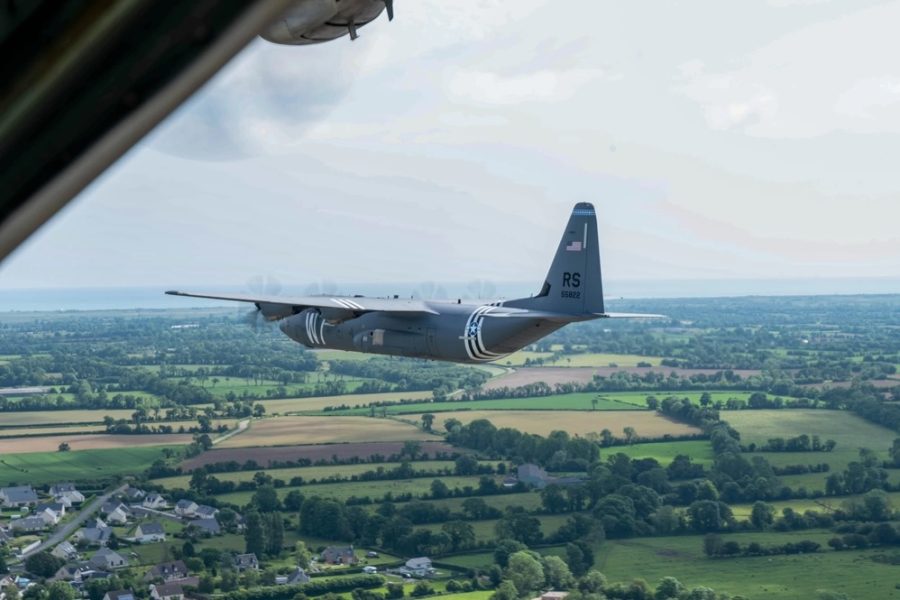
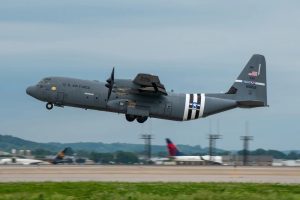
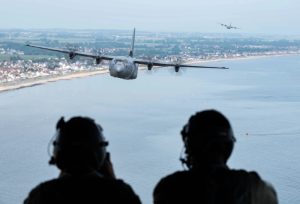
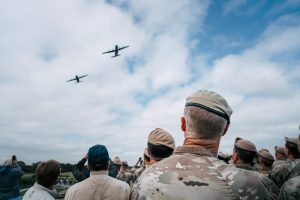
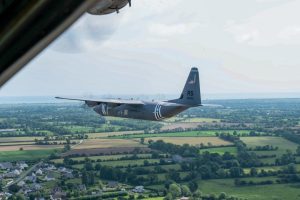
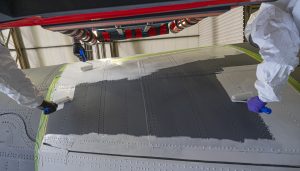
A U.S. Air Force C-130J Super Hercules assigned to the 37th Airlift Squadron, Ramstein Air Base, Germany, gets ready to fly over a commemorative ceremony for the 80th anniversary of D-Day at Sainte-Mere-Eglise, France, June 3, 2024. (U.S. Air Force photo by Senior Airman Jordan Lazaro)
Audio of this article is brought to you by the Air & Space Forces Association, honoring and supporting our Airmen, Guardians, and their families. Find out more at afa.org
Air Force crews flew over France this week in C-130 transport planes decked out in black-and-white “invasion stripes” for the 80th anniversary of D-Day, the June 6, 1944 battle where U.S. and allied troops began the liberation of Nazi-occupied France during World War II.
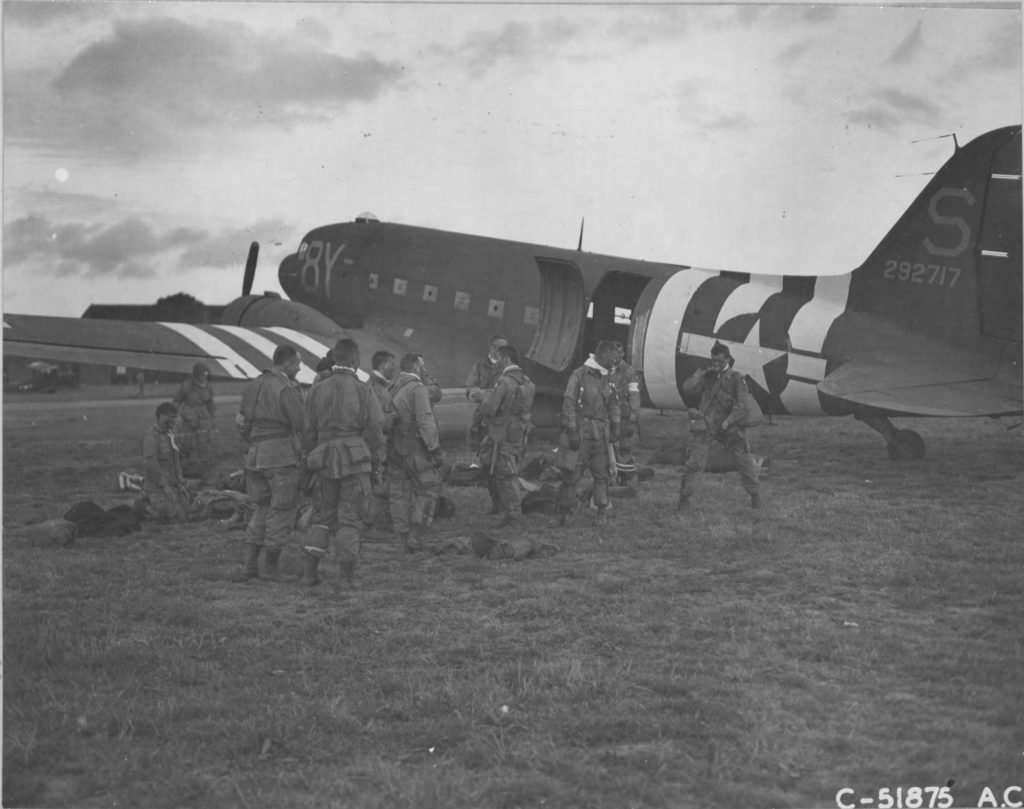
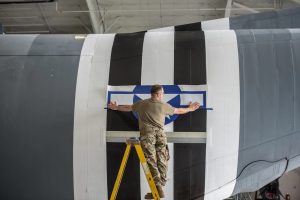
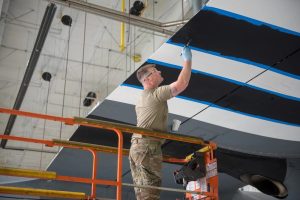
The stripes commemorate the patterns painted on allied aircraft during the invasion so that ground troops could quickly identify them as friendly forces. A year earlier, during the 1943 invasion of Sicily, Allied naval gunners mistakenly shot down 23 C-47 transports and heavily damaged another 37, killing dozens of paratroopers and air crew members.
“The incident would lead to better coordination between units and the black and white recognition stripes used on aircraft at Normandy,” according to the National World War II Museum.
Many of the stripes were hastily painted on June 3 for troop transports and June 4 for fighter and bomber squadrons—the short notice was part of an effort to keep the plan a secret, according to the National Air and Space Museum.
American paratroopers prepare to board their C-47 for their jump into Normandy. (U.S. Air Force photo / National Archives and Records Administration)
Over the years, many U.S. and allied air forces have sported the invasion stripes in honor of D-Day, including A-10 and F-15 fighter jets; C-17 and C-130 transport planes; and the United Kingdom’s Typhoon fighter jet.
For the 80th anniversary celebration, which will include dozens of events across France over several weeks, multiple USAF aircraft are sporting invasions stripes.
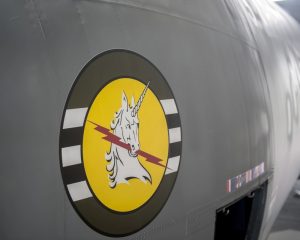
One is a C-130J assigned to the Kentucky Air National Guard. Besides the stripes, the Super Hercules also featured nose art based on the squadron patch of the WWII-era 368th Fighter Squadron which eventually became one of the first units of the Kentucky Air National Guard.
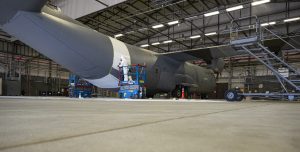
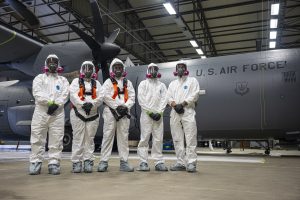
“I feel honored to be part of this 80th anniversary—to pay tribute to the men who gave so much so we could secure our freedom,” Master Sgt. Lee Stanley, aircraft structural shop chief for Kentucky’s 123rd Maintenance Squadron, said in a press release. Stanley led the paint effort, which started in late May.
“Designing the nose art is something I took a lot of pride in, and something I didn’t take lightly,” he added. “I wanted to make sure we got all the details historically accurate.”
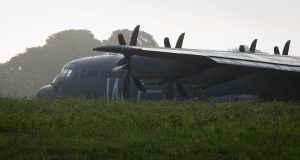
Multiple C-130s from Ramstein Air Base, Germany, also got the stripes, with maintainers painting them on months ago.
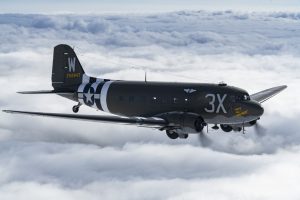
Also included in the celebration was the legendary C-47 “That’s All, Brother” that led more than 800 C-47 Skytrain transports that ferried troops and cargo on D-Day.
“A steady and proven aircraft, the C-47 earned for itself a reputation hardly eclipsed even by the more glamorous of combat airplanes,” wrote Air Mobility Command Museum in a tribute to the C-47, which was widely known as the “Gooney Bird.”
The C-47 also evacuated wounded troops, dropped flares for bombing attacks at night, flew reconnaissance and psychological warfare missions, and served as a gunship during the Vietnam War, the museum wrote
All told, more than a dozen U.S. Air Force aircraft are participating in the 80th anniversary events, mostly C-130s. The 93rd Air Ground Operations Wing from Moody Air Force Base, Ga., also sent 30 Airmen to parachute in a June 9 display.
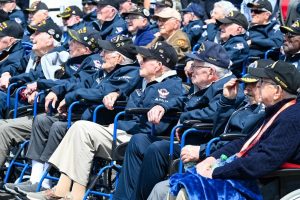
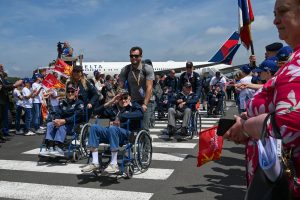
Several dozen D-Day veterans attended the 80th anniversary, which may be the last time many of them see invasion stripes flying overhead.
“For a lot of those guys who fought at D-Day, this might be the last chance they get to see this,” Stanley said. “So we really took a lot of care to make sure we got everything right.”
Audio of this article is brought to you by the Air & Space Forces Association, honoring and supporting our Airmen, Guardians, and their families. Find out more at afa.org
Seven F-22 Raptor pilots have recently been awarded one of the military’s highest decorations for their actions during operations in the Middle East. Six of the pilots were decorated with the Distinguished Flying Cross for their role in Operation Midnight Hammer, the June 2025 strikes against Iranian nuclear facilities.
Three T-7A Red Hawk trainer jets flew together at Joint Base San Antonio-Randolph, Texas, on Sept. 16—one physical aircraft in the air and two virtual ones controlled from simulators on the ground, all sharing one common operating picture.
The Air Force and Defense Innovation Unit have selected seven companies to move forward on a program meant to produce a low-cost, semi-autonomous drone to succeed the MQ-9A Reaper, multiple sources confirmed to Air & Space Forces Magazine.
The Air Force awarded Boeing a $2.38 billion contract for 22 F-15EX Eagle II fighters on Sept. 29, narrowly meeting a deadline to use funds from last summer’s reconciliation bill or face cuts.
The Navy has awarded Boeing a contract worth more than $20 billion to build its new carrier-based sixth-generation fighter, the F/A-XX. Boeing is also building the Air Force’s sixth-gen F-47.
The Pentagon on Sept. 28 announced a contract potentially worth $20.7 billion for RTX to build Advanced Medium-Range Air-to-Air Missiles used by Navy and Air Force aircraft and for ground-based interceptors.
For the past four years, the idea of autonomous drone warfare like Collaborative Combat Aircraft has been discussed as a future concept, rather than near-term reality. But now that promised vision appears imminent, with the Air Force promising at least 1,000 such drones by 2032.
The Air Force’s emerging Collaborative Combat Aircraft program would suffer delays if Congress fails to pass a budget before the end of this calendar year, a top service official said Sept. 28.
Six U.S. Air Force F-35A fighters and 200-plus Airmen deployed to India on Sept. 26 for their first appearance in a large-scale exercise on Indian soil.
✓
Thank You!
Check your inbox to verify your email address and finish setting up your AFA account.
★
Welcome Back!
An account with this email already exists. Please log in to continue.
Subscribe to the Air & Space Forces Daily Report
The latest news from Air & Space Forces Magazine, as well as news from other leading publications, delivered right to your inbox every morning!
We’re sorry, there has been an error. Please review your input or try again later.